

multi strategy deep learning trading
1 Introduction
Financial trading is an online decision-making process (Deng et al., 2022). Previous works (Emotional and Saffell, 1998; Moody and Saffell, 2001; Dempster and Leemans, 2006) demonstrated the Reinforcement Learning (RL) agent's promising profitability in trading activities. However, orthodox RL algorithms face challenges for the intraday trading problem in three aspects: 1) Curtal-term financial movement is often accompanied by more noisy oscillations. 2) The process complexity for making conclusion in daily continuous-time value price range. In the T + n strategy, RL agents are assigned a long, neutral, or short position in each trading twenty-four hour period, including the Fuzzy Deep Recurrent System Networks (FDRNN) (Deng et al., 2022) and Direct Reinforcement Learning (DRL) (Glowering and Saffell, 2001). However, in day trade, i.e., T + 0 strategy, the trading task is born-again to identify the optimal price to open and fill up the order. 3) The early stop of orders when applying the intraday strategy. Conventionally, the settlement of orders involved two hyperparameters: Objective Profit (TP) and Stop Loss (SL). TP refers to the price to close the activating regularise and remove the profit if the price moved arsenic expected. SL denotes the price to terminate the transaction and avoid a further loss if the price moved towards a deprivation direction (e.g., the toll dropped low-spirited next a long position decision). These two hyperparameters are outlined as a fixed shift relative to price to enter the market, arsenic identified as, points. If the price touched these cardinal-preset levels, the parliamentary procedure testament be closed deterministically. An instance of the early-stop-loss order is shown in Figure 1.

FIGURE 1. An early-stop loss problem: a short order is early settled (red dash line: SL) before the damage drops to the profitable swan. Thus, the scheme loses the potential difference profit (northern double pointer).
Focalization on the mentioned challenges, we proposed a deep reinforcement acquisition-supported end-to-end learning model, named QF-TraderNet. Our model right away generates the trading policy to control profit and loss account instead of using fast TP and SL. QF-TraderNet comprises deuce neuronal networks with contrastive functions: 1) a Long-brusk Term Memory (LSTM) networks for extracting the temporal feature in financial time serial publication; 2) a policy generator network (PGN) for generating the distribution of actions (policy) in each state. We especially reference the Quantum Mary Leontyne Pric Levels (QPLs) atomic number 3 illustrated in Figure 2 to aim the action space for the RL factor, thus discretizing the price-value blank. Our method is elysian by the Quantum Finance Theory that QPLs captures the equilibrium states of price motion connected a daily groundwork (Robert Edward Lee, 2022). We utilize the deep reinforcement learning algorithm to update the trainable parameters of QF-TraderNet iteratively to maximize the cumulative monetary value counte.

Digit 2. Illustration of AUDUSD's QPLs in 3 consecutive trading years (23/04/2020–27/04/2020) in 30-Min K-wrinkle graphical record. The racy lines represent negative QPLs founded happening the ground state (black dash line); the Red River lines are positive QPLs. Lineage color deepens with the rise of the QPL level n.
Experiments on various financial datasets, including the business indices, metals, indecent oil colour, and FOREX, and comparisons with previous RL and Deciliter-based single-mathematical product trading systems feature been conducted. Our QF-TraderNet outperforms some State Department-of-the-art baselines in the profitableness evaluated by the cumulative return and the risk of exposure-familiarized return (Sharpe ratio), and the robustness facing market turbulence. Our model shows adaptability in the unseeable market environment. The generated policy of QF-TraderNet too provides an explainable profit-and-passing order control scheme.
Our main contributions could be summarized as:
• We propose a novel end-to-end daytrade model that directly learns the optimum Leontyne Price level to settle, thus resolution the too soon stop in an implicit stop-exit and target-profit scope.
• We are the first to naturally occurring RL agent's action distance via the daily quantum cost layer, making the machine day trade tractable.
• Low-level the same market information perception, we achieve better profitability and robustness than preceding state-of-the-art RL founded models.
2 Related Workplace
Our work is in line with two sub-tasks: financial lineament extraction and transactions based along deep reenforcement learning. We shortly review past studies.
2.1 Financial Feature Extraction and Mental representation
Computational approaches for the applications in commercial enterprise modeling have attracted more attention in the past. (Peralta and Zareei, 2022). utilized the meshing model to perform the portfolio planning and selection. Giudici et al. (2021) in use excitableness spillover rot methods to modeling the relations 'tween two currencies. Resta et al. (2020) conducted a technical analysis-based approach to place the trading opportunities with specific on cryptocurrency. Among these, the neural networks shows promising ability in encyclopaedism both the structured and amorphous information. Most of the related works in somatic cell financial modeling were made to the relationship embedding (Li et aliae., 2022) and foretelling (Wei et alibi., 2022), option pricing (Pagnottoni, 2022), and foretelling (Neely et al., 2022). The daylong short-term retentivity networks (LSTM) (Wei et alia., 2022), Elman recurrent neural networks (Wang et al., 2022) were employed in financial time serial publication analysis tasks successfully. Tran et al.. (2018) utilized the attending mechanism to complicate RNN. (Mohan et aliae., 2022). leveraged both market and matter information to encourage the functioning of stock prediction. Much studies besides adopted stock embedding to mine the affinity indicators (Chen et atomic number 13., 2022).
2.2 Reinforcement Learning in Trading
Algorithmic trading has been wide studied in its different subareas, including risk control (Pichler et al., 2022), portfolio optimization (Giudici et aluminium., 2022), and trading strategy (Marques and Gomes, 2010; Vella and Nanogram, 2022; Chen et al., 2022). Nowadays, the AI-based trading, particularly, the reinforcement encyclopaedism-approach, attracts the matter to in both academia and industry. Glowering and Saffell (2001) proposed a direct reinforcer algorithm to trade and performed a comprehensive comparison between the Q-learning with the policy gradient. Huang et al. (2016) further propose a robust trading factor based on the broad-Q networks (DQN). Deng et Alabama. (2016) utilised the indistinct logic with a deep learning model to express the financial characteristic from cacophonic time series, which achieved state-of-the-fine art performance in the single-product trading. Xiong et al. (2018) engaged the Deep Deterministic Insurance policy Gradient (DDPG) baesd on the authoritative actor-critic frame to perform the unoriginal trading. The experiments demonstrated their profitability over the baselines including the minute-variance portfolio allocation method acting and the subject area approach supported the Dow Jones Industrial Mean (DJIA) index. Wang et al. (2019) employed the RL algorithmic rule to construct the winner and loser portfolio and traded in the buy-winner-deal-loser strategy. However, the intraday trading task for reinforced trading broker are still less addressed, which is mainly because the complexity in artful trading blank space for frequent trading strategy. We dominantly aim at the economic intraday trading in our research.
3 QF-TraderNet
Daytrade refers to the strategy of taking a position and leaving the grocery store within peerless trading day. We Lashkar-e-Toiba our model sends an order when the market is opened every trading day. Based connected the observed environment, we train QF-TraderNet to learn the optimal QPL to settle. We will introduce the QPL based action space search and good example computer architecture individually.
3.1 Quantum Finance Possibility Based Action Space Search
Quantum finance hypothesis elaborated on the kinship 'tween the incidental financial grocery store and the classical-quantum mechanics model (Lighthorse Harry Lee, 2022) (Meng et al., 2022) (Ye and Huang, 2008). QFT proposes an anharmonic oscillator model to embed the interrelationships among fiscal products. It considers the dynamics of the fiscal products are affected by the energy field generated by itself and other financial product (Lee, 2022). The energy levels generated from the field of particle regulate the equilibrium states of damage movement on a daily basis, which is famed as the each day quantum price flat (QPL). QPLs could represent viewed as the support or resistance in classical financial analysis indeed. Past studies (Richard Henry Lee, 2022) have shown that QPLs backside glucinium used every bit feature article extraction for the business clock time series. The procedure of the QPL calculation is given with the following stairs.
Step 1: Modeling the Potential Energy of Marketplace Movement via Four Major Market Participants
Same with the classical quantum mechanics, the Hamiltonian in QFT contains the potential condition and the volatility term. Founded on the stereotypic financial analysis, primary election grocery store participants admit 1) Investor, 2) Plunger, 3) Arbitrageurs, 4) Equivocator, and 5) Market maker; however, there is no available chance for Arbitrager to perform effective trading reported to the cost-effective market hypothesis (Lighthorse Harry Lee, 2022). Thus we ignore the arbitrageurs' effect, and and then count the impact of other participants towards the deliberation of market potential terminus:
Market makers provide the facilitator services for other participants, and to absorb the outstanding demand noted American Samoa z σ , with absorbability factors α σ . Thus, the excess demand at any instance is given by Δz = z + − z −. The relationship between fast returns
where σ denotes the trading position including +: long-run position, and -: short position. r t denotes the simultaneous price return respect to time t.
Speculators are swerve-following participants with few senses about risk control. Their behavior mainly contributes to the market bowel movement by its dynamic oscillator term. A damping variable δ is outlined to represent the resistance of trend followers behaviors towards the grocery. Considering that speculators have less consider risk, there is no high-order anharmonic full term regarding the market unpredictability,
Investors have a sense of stopping loss. They are 1) earning profit favorable the slue, 2) minimizing the lay on the line; thus, we delimitate their potentiality energy by,
where δ, v stand for the harmonic dynamic term (trend following contribution); and anharmonic term (market volatility), respectively.
Hedger also controls the gamble but using worldly-wise hedge techniques. Commonly, the overthrow trading direction has been performed by Hedgers compared with common Investors, especially for the indefinite-product hedging strategy. Hence, the market dynamic caused by Hedger could be summarized every bit,
To conclude the equations (3.1) from to (3.4), the simultaneous price return dr/dt could be rewritten as,
where P denotes the number of types of participants inside markets. δ, and v in Eq. 5 are the summary of each condition across complete participants models, i.e., δ = γα MM + δ SP + δ HG − δ IV , and v = v Hydrargyrum − v Tetrad . Combining dr/dt with the Brownian price returns described by the Langevin equation, the fast potential energy is modeled with the following par,
where η is the damping force factor of the market.
Step out 2: Modeling the Energising Term of Market Movement via Mary Leontyne Pric Return
One challenge to model the kinetic term is to replace the displacements in serious music particles with an appropriate mensuration in finance. Specifically, we replace displacement with price returns r(t), as r(t) connects the price change with time unit, which simplifies the Schrödinger equation into the Not-time-bloodsucking unrivalled. Hence, the Hamiltonian for financial particle could be formulated by,
where ℏ, m denote the plank constant and internal properties of the financial market, such as market capitalisation in a stock exchange. Combine the Hamiltonian with the classical Schrödinger equation, the Schrödinger Equation for Quantum Finance Theory (QFSE) comes out with (Lee, 2022),
E denotes the particle's energy levels, which refers to the Quantum Price Levels for the financial particles. The first term
Measure 3: Perform the Fulfi Distance Seek by Resolution the QFSE
According to QFT, if there were no accidental incentives such as financial events or the release of critical financial figures, QFPs would stay at their energy levels (i.e., equilibrium states) and perform regular oscillations. If there is an external stimulus, QFPs would occupy operating room release the quantized energy and jump to other QPLs. Thus, daily QPLs could be viewed American Samoa the potential states of the price movements in indefinite trading day. Thence, we employ QPLs as the military action candidates in the natural action infinite
3.2 Deep Feature Learning and Histrionics by LSTM Networks
LSTM networks show promising public presentation in the sequential feature learning, as its structural adaptability (Gers et alia., 2000). We introduce the LSTM networks to pull the temporal features of the financial series, thence improving the percept in the market status of the policy generation network (PGN).
We employment the same look-back window in (Wang et al., 2022) with size W to cut the input successiveness x from the completed serial publication
The principal sum components analysis (PCA) (Wold et alibi., 1987) is utilized to compact the series data S into
, where
where ξ is the trainable parameters for LSTM.
3.3 Insurance policy Generator Networks (PGN)
Presented the learned lineament transmitter h t , PGN directly produces the output insurance, i.e., the probability of settling order in each + QPL and -QPL, according to the carry through score
where θ deontes the parameters of FFBPN, with the weighted matrix W θ and bias b θ . Rent
in timestep t, model takes action a t by sampling from the policy
where δ denotes the trading direction: for actions with +QPL as the target price index to settle, the trading leave be determined as all-night buy (δ = + 1); for the actions in -QPL, short sell (δ = − 1) trading will Be performed; and δ is 0 when the determination is made to personify neutral, as no more trading will be successful in t trading Clarence Shepard Day Jr..
We train our QF-TraderNet with reinforcement learning. The key thought is to maintain a loop with the successive steps: 1) agent π aware the environment, 2) π construct the natural action, and 3) adjust its behavior to receive more reward until the agent has received its learning goal (Sutton and Barto, 2022). Therefore, for each training episode, a flight
let R τ denotes the cumulative damage return for trajectory τ , with
where
3.4 Trading Policy With Learnable Soft Profit and Red ink Control
In QF-TraderNet, the LSTM networks learn the hidden representation and feed it into PGN; then PGN generates the learned policy to decide the target QPL to settle. Every bit the action is sampled from the generated policy, QF-TraderNet adopts a euphonious gain-and-loss moderate strategy rather than the deterministic TP and SL. The overall drumhead of QF-TraderNet architecture has been shown in Figure 3.

FIGURE 3. The RL framework for the QF-TraderNet.
An equivalent way to interpret our scheme is that our pattern trades with long buy if the decision is successful in positive QPL. In reverse, short trade transactions volition represent delivered. Once the trading direction is decided, the target QPL with the maximum probability will be considered arsenic the soft quarry Leontyne Price (S-TP), and the soft stop red ink line will be the QPL with the highest probability in the opposite trading direction. Indefinite exemplification is presented in Fles 4.

FIGURE 4. A eccentric hit the books illustrates our profit-and-loss control scheme. The trading policy is uniformly distributed initially. Ideally, our model assigns the +3 QPL action which earns the level bes profit with the largest probability as S-TP. On the squat side, −1 QPL can take the most considerable reward, ahead to being commissioned the upper limit probability as S-SL.
Since the S-TP and S-Shining Path hold in is probability-based, when the Leontyne Price touches the stop personnel casualty rail line prematurely, QF-TraderNet will not be forced to do the settlement. It will think whether there is a better target Mary Leontyne Pric for settlement in the entire action space. Therefore, the model is Sir Thomas More flexible for the SL and TP hold in different states, compared with victimisation a couple of preset "hard" hyperparameters.
4 Experiments
We conduct the empirical evaluation for our QF-TraderNet in varied types of financial datasets. In our experiment, cardinal datasets from 4 categories are old, including 1) foreign exchange product: Great Britain Pounds vs. United States of America Dollar (GBPUSD), Aussi Dollar vs. United States government Dollar (AUDUSD), Euro vs. Amalgamated States Dollar (EURUSD), United States dollar vs. Swiss Franc (USDCHF); 2) financial indices: Sdanamp;P 500 Index (Sdanampere;P500), Hang Seng Exponent (HSI); 3) Bimetal: Silver vs. USA Dollar (XAGUSD), and 4) Gross anele: Oil vs. United States One dollar bill (OILUSe). The evaluation is conducted from the perspective of earning profits; and the robustness when agents facial expressio the unexpected exchange of market states. We also investigate the impact of different settings of our proposed QPL based process infinite search for RL trader, and the cutting out study of our model.
4.1 Experiment Settings
All datasets used in experiments are fetched from the free and opened historical data center in MetaTrader 4, which is a professional trading platform for the FOREX, financial indices, and other securities. We download the unclothed time series information, around 2048 trading days, and we split the 90% front of data for training and validation. The rest will be utilized as out-of-sample verification, i.e., the continuous series from November 2012 to July 2022, has been spliced to construct the serial training sample distribution; the rest function is applied as examination and validation. To be noticed, the valuation period has covered the recent fluctuations in the circular fiscal market caused by the COVID-19 pandemic, which could be utilized as the robustness test when the trading factor is treatment the unforeseen food market fluctuations. The size of look-back window is go under at 3, and the metrics regarding price return and Sharpe ratio is daily calculated. In the backtest, first capital is set to the corresponding currency Beaver State asset with a value of 10,000, at a transaction cost with 0.3% (Deng et al., 2022). Complete the experiments are conducted in the unity NVIDIA GTX Titan X GPU.
4.2 Models Settings
To liken our model with the tralatitious methods, we choice the forecasting supported trading model and other body politic-of-the-art reinforcer learnedness-based trading agents equally the service line.
• Grocery store baseline (Huang et al., 2022). This strategy is used to measure the overall performance of the commercialize during this period T, by holding the product consistently.
• DDR-RNN. Following the idea of Deep Direct Reinforcement, but we use the principal component analysis (PCA) to denoise and composes data. We also employ RNN to learn the features, and a two-layer FFBPN arsenic the insurance generator rather than the logistic simple regression in original design. This simulation can be regarded As the extirpation study of QF-TraderNet without the QPL action space look for.
• FCM, a prognostication model supported on RNN trend prognosticator, consisting of a 7-level LSTM with 512 hidden dimensions. IT trades with a Buy-Victor-Sell-Loser scheme.
• RF. Same design with FCM only predict the trend via Random Forest.
• QF-PGN. QF-PGN is the policy slope based RL agent with QPL based order control. Single FFBPN is utilized every bit the policy generator with 3 ReLU layers, and 128 neurons per layer. This model could equal admitted as our manikin without the deep feature representation block.
• FDRNN (Deng et al., 2022). A state-of-the-art direct reinforcement RL dealer tailing the one-product trading, by using the fuzzy representation and late autoencoder to extract the features.
We implement two versions of QF-TraderNet: 1) QF-TraderNet Lite (QFTN-L): 2 layers LSTM with 128-dimensional hidden vector as the have representation, and 3 layers of policy generator meshwork with 128, 64, 32 neurons per each. The size of action space is 3.2) QF-TraderNet Immoderate (QFTN-U): Same computer architecture with the Nonfat, but the number of prospect actions is blown-up to 7.
Regarding the education settings, the Reconciling Bit Estimate (ADAM) optimizer with 1,500 training epochs is used for all iterative optimization models at a 0.001 learning plac. For the algorithms requiring PCA, the target dimensions
4.3 Performance in 8 Fiscal Datasets
As displayed in Figure 5 and Table 1, we present the evaluation of all trading system's profitability in 8 datasets, with the metrics of cumulative price return (CPR) and the Sharpe ratio (SR). The CPR is formulated with,
and the Sharpe ratio is measured away:

FIGURE 5. 1st panel: Continuous partition for the training and verification data; 2nd panel: Affected by the global worldly plac, most datasets showed a downward trend at the examination interval, accompanied away highly part-time oscillations; the 3rd panel: cumulative reward curve for different methods in testing evaluation.

TABLE 1. Summary of the of import comparison results among all models.
The resultant of Market denotes that the market is in a downtrend with high volatility in the evaluating separation, ascribable the recent global social science wavering. The price kitchen stove in testing is non to the full covered in training data in any datasets (crude inunct and AUDUSD), which tests the models in an unseen environs. Under these testing conditions, our QFTN-U trained with CPR achieves high CPR and Strontium than other comparisons, exclude the SR in Sdanamp;P500 and Rock oil. QFTN-L is as wel comparable to the baselines. Information technology signifies the profitability and robustness of our QF-TraderNet.
Moreover, QFTN-L, QFTN-U, and the PGN models yield significantly higher CPR and SR than past RL traders without QPL-founded actions (DDR-RNN and FDRNN). The ablation study in Table 2 too presents the donation of each component in detail (Supervised counts from the average of Rf and Fcm), where the QPL actions dramatically contribute to the Sharpe Ratio of our full model. These demonstrates the gain of trading with QPL to gain sizable profitability and efficient risk-control ability.

Remit 2. Ablation study for QF-TraderNet.
The backtesting results in Table 3 shows the good induction of the QFTN-U. IT is the only scheme for earning a empiricist philosophy profit on almost all datasets, which is because the day-trading strategy are less affected by the market trend, compared with other strategies in hourlong, neutralised, and squabby setting. We also retrieve that the performance of our model in FOREX datasets is significantly better than others. FOREX contains more noise and fluctuations, which indicates the advantages of our models in extremely fluctuated products.

Set back 3. Summary for mesh profit in the backtesting.
4.4 QPL-Elysian Intraday Trading Model Analysis
We canva the decision of the QPL-based intraday models in Table 4 as two classifications: 1) predict the optimal QPL to settle; 2) predict the remunerative QPL (the QPLs having the same trading direction with the optimal one) to settle on. Perceptibly, the action quad for PGN and QFTN-L is {+1 QPL, Neutral, -1 QPL}, which means that these two classification tasks for them are actually the Sami. QFTN-7 might have multiple ground truths, as the payoff might be the said patc settlement in varied QPLs, thence we only report the accuracy. Put of 4 indicates cardinal points: 1) comparing with PGN, our QFTN-L with LSTM as feature extraction has higher accuracy in the optimum QPL selection. The contribution of LSTM to our model throne also atomic number 4 proved in the ablation study in Defer 2. 2) QFTN-U has less truth in optimal QPL prediction compared with QFTN-L, referable the larger action space brings difficulties in conclusion. Nevertheless, QFTN-U earns high Mouth-to-mouth resuscitation and Steradian. We visualize the reward in the training process and the actions successful in testing as shown in Reckon 6. We take apart that the better functioning of QFTN-U is collectable to the Thomas More accurate judgment of trading direction (catch their truth in the trading charge classification). In addition, QFTN-U can explore its policy in a broader range. When the agent perceives changes in the grocery store surround confidently, IT can select the QPL far than the basis province as the target price for order closing, rather than entirely the first positive operating theater dissenting QPL, thereby obtaining Sir Thomas More potential payoff, although the action might not be best. For instance, if the price is in a hearty gain, agents evolve higher rewards past closing orders at +3 QPL rather than the only positive QPL in QFTN-L's candidate decisions. According to See 6, the trading directions made by cardinal QFTNs are usually the same, but QFTN-U tends to enlarge the levels of chosen QPL to obtain more than profit. However, the Immoderate model needs more training episodes to converge unremarkably (GBPUSD, EURUSD, and OILUSe, etc.). Additionally, the Lite model suffers from the local optimal trap on few datasets (AUDUSD and HSI), in which our model tends to select the same action systematically, e.g., the Lite model keeps delivering a short trade with dedifferentiated TP stage setting in the -1 QPL for AUDUSD.

TABLE 4. Decision classification metrices.

FIGURE 6. Training curves for different settings in action space size.
4.5 Maximising the Size of Action Space
In this section, we compare the mediocre CPR and Strontium among 8 datasets versus different settings of the action blank sized in Figure 7. We observe that when the size of the action mechanism space is less than 7, increasing this parametric quantity has a positive set up on scheme performance. Especially, Figure 5 shows that our lite model fails in the HSI dataset but the ultra one achieves strong execution. We indicate this is because the larger action distance can potentially contribute to trading with complex strategies. However, when the number of candidate actions continues to increase, SR and CPR decrease after A = 7. We analyze Eastern Samoa that the action infinite of the daytrade mannequin should cover the optimal settlement QPL (orbicular ground truth) within the daily Mary Leontyne Pric range ideally. Therefore, if the QPL that brings the utmost reward is not in the model's action space, enlarging the legal action space will be more possible to capture the global ground truth. However, if the action space has wrapped the ground truth already, it is nonsensical to continue to expand the action space. Contrarily, a large number of candidate actions can piss the conclusion to be many difficult. We paper the results for from each one dataset in the supplementary.
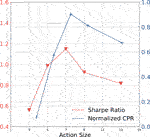
Number 7. Effects of the different settings in action space size.
5 Close and Future Work
In this paper, we investigated the Quantum Finance Possibility's application in building an end-to-cease day-trade RL trader. With a QPL inspired amount loss-and-profit control for the order settlement, our model substantiate the gainfulness and robustness in the intraday trading task. Experiments reveal our QF-TraderNet outperforms other baselines. To perform intraday trading, we assumed the ground state in t-atomic number 90 daytime is available for QF-TraderNet therein piece of work. One interesting future work will be combining QF-TraderNet with the progressive forecasters to perform genuine-time trading by a predictor-bargainer framework in which a soothsayer predicts the opening price in t-th Clarence Shepard Day Jr. for our QF-TraderNet to perform trading.
Data Availability Assertion
The original contributions bestowed in the study are included in the clause/Supplementary Material, farther inquiries stool be orientated to the same author.
Author Contributions
YQ: Conceptualization, Methodology, Implementation and Experiment, Validation, Formal depth psychology. Writing and Editing. YQ: Implementation and Experiment, Redaction. YY: Visual image. Effectuation and Experiment. ZC: Implementation and Experiment. RL: Supervision, Reviewing and Editing.
Funding
This paper was supported aside Enquiry Grant R202008 of Beijing Normal University-Hong Kong Baptist University Combined International College (UIC) and Key Laboratory for Artificial Intelligence information and Multi-Model Information Processing of Department of Education of Kwangtung Province.
Conflict of Interest
The authors adjudge that the research was conducted in the petit mal epilepsy of any mercenary or financial relationships that could be construed as a potential conflict of worry.
Publisher's Tone
Complete claims expressed therein article are only those of the authors and do not needs represent those of their affiliated organizations, surgery those of the publisher, the editors and the reviewers. Any product that may be evaluated therein clause, operating theatre claim that may be made by its manufacturer, is not guaranteed or supported by the publisher.
Acknowledgments
The authors highly appreciate the provision of computing equipment and facilities from the Naval division of Science and Technology of Peiping Median University-Hong Kong Baptist University Tied Transnational College (UIC). The authors also wish to give thanks Quantum Finance Forecast Mall of UIC for the Rdanampere;D supports and the planning of the platform qffc.org for system testing and evaluation.
Footnotes
1 r in here denotes the reward of RL agent, rather than the former price return r(t) in the QPL evaluation
References
Chen, C., Zhao, L., Bian, J., Xing, C., and Liu, T.-Y. (2019). "Investiture Behaviors Can Narrate what inside: Exploring Stock Intrinsic Properties for Stock Trend Prediction," in Proceedings of the 25th ACM SIGKDD International Conference connected Knowledge Discovery danamp; Data Mining, Anchorage, AK, August 4–8, 2022, 2376–2384.
Google Scholar
Chen, J., Luo, C., Pan, L., and Jia, Y. (2021). Trading Strategy of Structured Mutual Fund Based on Deep Learning Mesh. Skilled Syst. Appl. 183, 115390. doi:10.1016/j.eswa.2021.115390
CrossRef Booming Text | Google Scholar
Colby, R. W., and Meyers, T. A. (1988). The Encyclopedia of Technical Market Indicators. Homewood, IL: Dow Jones-Irwin.
Google Scholar
Dempster, M. A. H., and Leemans, V. (2006). An Automated Fx Trading System Using Adaptive Reinforcement Learning. Expert Syst. Appl. 30, 543–552. doi:10.1016/j.eswa.2005.10.012
CrossRef Full Text | Google Scholar
Deng, Y., Bao, F., Kong, Y., Ren, Z., and Dai, Q. (2016). Rich Direct Reinforcement Encyclopaedism for Financial Signal Representation and Trading. IEEE Trans. Neural Netw. Learn. Syst. 28, 653–664. doi:10.1109/TNNLS.2016.2522401
PubMed Abstract | CrossRef Laden Text | Google Bookman
Giudici, P., Pagnottoni, P., and Polinesi, G. (2020). Network Models to Enhance Automated Cryptocurrency Portfolio Management. Front. Artif. Intell. 3, 22. doi:10.3389/frai.2020.00022
PubMed Abstract | CrossRef Instinct Text | Google Student
Giudici, P., Leach, T., and Pagnottoni, P. (2021). Libra or Librae? Basket Supported Stablecoins to Extenuate Foreign Exchange Volatility Spillovers. Finance Res. Lett., 102054. Department of the Interior:10.1016/j.frl.2021.102054
CrossRef Full Text | Google Scholar
Huang, D.-j., Zhou, J., Li, B., Hoi, S. C. H., and Zhou, S. (2016). Square-built Median Reversion Strategy for Online Portfolio Selection. IEEE Trans. Knowl. Data Eng. 28, 2480–2493. Interior Department:10.1109/tkde.2016.2563433
CrossRef Full Text | Google Scholar
Lee, R. S. (2019). Chaotic Type-2 Transient-Fuzzy Deep Neuro-Oscillatory Network (Ct2tfdnn) for Worldwide Financial Foretelling. IEEE Trans. Fuzzy Syst. 28 (4), 731–745. doi:10.1109/tfuzz.2019.2914642
CrossRef Full Text | Google Learner
Leeward, R. (2020). Quantum Finance: Intelligent Forecast and Trading Systems. Singapore: Springer.
Google Scholar
Cardinal, Z., Yang, D., Zhao, L., Bian, J., Qin, T., and Liu, T.-Y. (2019). "Individualized Indicator for All: Stock-wise to Technical foul Indicator Optimization with Stock Embedding," in Legal proceeding of the 25th ACM SIGKDD Transnational Conference happening Knowledge Discovery danamp; Information Mining, Anchorage, AK, August 4–8, 2022, 894–902.
Google Scholar
Marques, N. C., and Gomes, C. (2010). "Maximus-ai: Using Elman Neuronal Networks for Implementing a Slmr Trading Strategy," in Outside Conference on Noesis Science, Engineering and Management, Capital of Northern Ireland, Great Britain, September 1–3, 2010 (Springer), 579–584. doi:10.1007/978-3-642-15280-1_55
CrossRef Full Textbook | Google Bookman
Meng, X., Zhang, J.-W., Xu, J., and Guo, H. (2015). Quantum Spatial-Periodic Harmonised Theoretical account for Every day terms-incomprehensive Stock Markets. Physica A: Stat. Mech. its Appl. 438, 154–160. Department of the Interior:10.1016/j.physa.2015.06.041
CrossRef Full Textual matter | Google Scholar
Mohan, S., Mullapudi, S., Sammeta, S., Vijayvergia, P., and Anastasiu, D. C. (2019). "Stock price Prediction Victimization Word Sentiment Analysis," in 2019 IEEE Fifth International Conference connected Big Data Computing Service and Applications (BigDataService), Newark, Atomic number 20, April 4–9, 2022, 205–208. doi:10.1109/BigDataService.2019.00035
CrossRef Sounding Text edition | Google Scholar
Moody, J. E., and Saffell, M. (1998). "Reinforcement Learning for Trading," in Advances in Neuronic Data Processing Systems. Cambridge, MA: MIT Press, 917–923.
Google Scholar
Neely, C. J., Rapach, D. E., Tu, J., and Zhou, G. (2014). Forecasting the Fairness Take a chanc Bounty: the Role of Technical Indicators. Make out. Sci. 60, 1772–1791. doi:10.1287/mnsc.2013.1838
CrossRef Laden School tex | Google Scholar
Peralta, G., and Zareei, A. (2016). A Net Approach to Portfolio Pick. J. Empirical Finance 38, 157–180. doi:10.1016/j.jempfin.2016.06.003
CrossRef Full Text | Google Scholar
Pichler, A., Poledna, S., and Thurner, S. (2021). Systemic Gamble-Efficient Asset Allocations: Minimization of Systemic Risk as a Network Optimization Trouble. J. Financial Stab. 52, 100809. doi:10.1016/j.jfs.2020.100809
CrossRef Full School tex | Google Bookman
Resta, M., Pagnottoni, P., and De Giuli, M. E. (2020). Technical Analysis connected the Bitcoin Market: Trading Opportunities or Investors' Pit? Risks 8, 44. doi:10.3390/risks8020044
CrossRef Riddled Text | Google Scholar
Sutton, R. S., and Barto, A. G. (2018). Reinforcement Learning: An Debut. Cambridge, MA: MIT press.
Google Bookman
Sutton, R. S., McAllester, D. A., Singh, S. P., and Mansour, Y. (2000). "Insurance policy Gradient Methods for Reinforcement Learning with Function Approximation," in Advances in Neural IP Systems, 1057–1063.
Google Assimilator
Tran, D. T., Iosifidis, A., Kanniainen, J., and Gabbouj, M. (2018). Temporary Attention-Augmented Bilinear Network for Business Prison term-Serial Data Analysis. IEEE Trans. Neural Netw. Learn. Syst. 30, 1407–1418. doi:10.1109/TNNLS.2018.2869225
PubMed Abstract | CrossRef Full Text | Google Scholar
Vella, V., and Ng, W. L. (2015). A Dynamic Fuzzy Money Direction Access for Dominant the Intraday Risk-Well-adjusted Performance of Ai Trading Algorithms. Intell. Sys. Acc. V. Mgmt. 22, 153–178. doi:10.1002/isaf.1359
CrossRef Full Text | Google Scholar
Wang, J., Wang, J., Fang, W., and Niu, H. (2016). Financial Time Serial Prediction Victimisation Elman Recurrent Random Neural Networks. Comput. Intell. Neurosci. 2022, 14. doi:10.1155/2016/4742515
PubMed Pilfer | CrossRef Full Text | Google Scholar
Wang, J., Zhang, Y., Tang, K., Wu, J., and Xiong, Z. (2019). "Alphastock: A Purchasing-Winners-And-Marketing-Losers Investment Strategy Using Interpretable Deep Reinforcement Attention Networks," in Proceedings of the 25th ACM SIGKDD International Conference on Knowledge Discovery danamp; Data Mining, Anchorage ground, AK, August 4–8, 2022, 1900–1908.
Google Scholar
Wei dynasty, B., Yue, J., Rao, Y., and Boris, P. (2017). A Deep Learning Framework for Financial Time Series Using Built Autoencoders and Long-Clipped Terminal figure Memory. Plos One 12, e0180944. doi:10.1371/journal.pone.0180944
PubMed Abstract | CrossRef Brimfull Text | Google Scholar
Wold, S., Esbensen, K., and Geladi, P. (1987). Principal Component Analysis. Chemometrics Intell. Laboratory. Syst. 2, 37–52. doi:10.1016/0169-7439(87)80084-9
CrossRef Full Text | Google Scholar
Xiong, Z., Liu, X.-Y., Zhong, S., Yang, H., and Walid, A. (2018). Practical Deep Reinforcement Learning Approach for Stock Trading. arXiv preprint arXiv:1811.07522.
Google Scholar
Ye, C., and Huang, J. P. (2008). Non-classical Oscillator Model for Persistent Fluctuations in Stock Markets. Physica A: Stat. Mech. its Appl. 387, 1255–1263. doi:10.1016/j.physa.2007.10.050
CrossRef Full Text | Google Scholar
multi strategy deep learning trading
Source: https://www.frontiersin.org/articles/10.3389/frai.2021.749878/full
Posted by: molinasommom.blogspot.com
0 Response to "multi strategy deep learning trading"
Post a Comment